

TL;DR:
- Streetwear fashion cycles include five stages: emergence within subcultures, rapid growth fueled by social media, mainstream saturation at the peak, decline due to oversaturation, and revival after approximately 20 years.
- Community validation, scarcity, and nostalgia drive trend adoption and revival, with social media compressing cycle durations from years to months.
Streetwear fashion cycles are defined as the repeating pattern of emergence, growth, peak, decline, and revival that governs how urban styles rise and fall in cultural relevance. Understanding fashion cycles in streetwear means recognizing that no trend dies permanently. It either gets buried by oversaturation or resurfaces with a fresh twist once the cultural memory of it fades. What separates streetwear from traditional fashion is that its cycles are driven not by runway seasons but by community validation, scarcity economics, and the speed of platforms like TikTok and Instagram. If you want to read trends before they peak, you need to understand the mechanics behind them.
How fashion cycles work in streetwear: the five stages
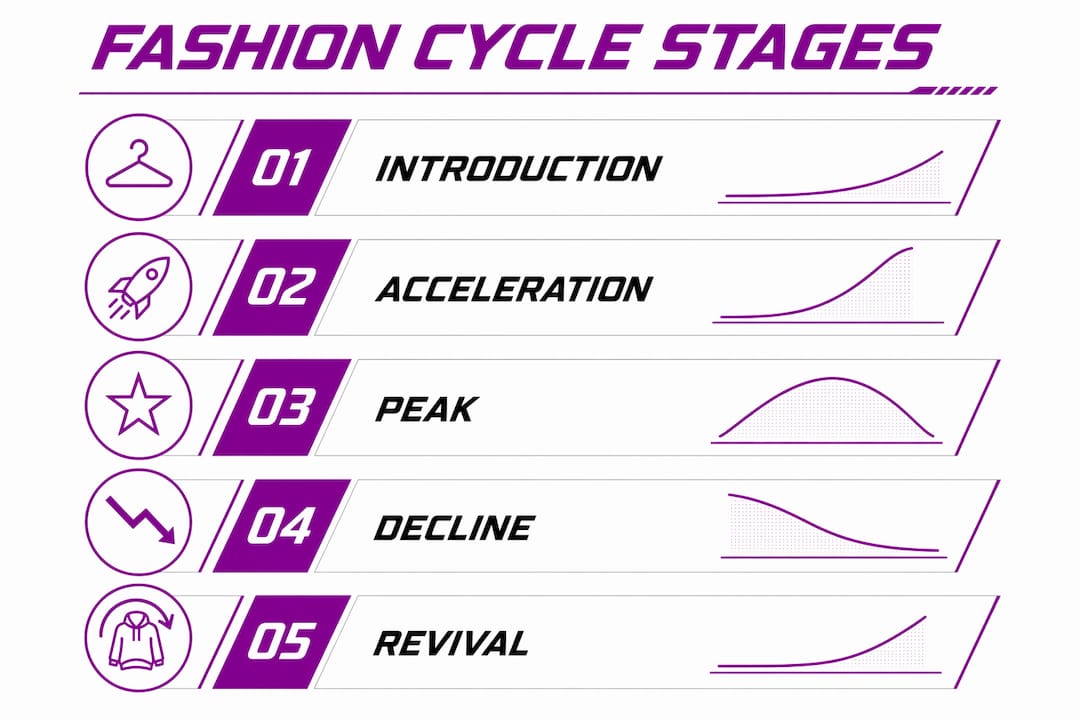
Streetwear trend cycles follow a four-to-five-step pattern that mirrors broader fashion life cycles but operates on its own cultural logic. Each stage has distinct signals you can learn to spot.
-
Introduction. A style emerges inside a tight subculture, whether that is a skate crew in Los Angeles, a hip-hop collective in New York, or a niche online community on Reddit or Discord. Adoption is intentionally small. The look carries meaning because only insiders wear it.
-
Acceleration. Influencers, athletes, and musicians pick up the style. Brands like Supreme, Off-White, or Fear of God release limited drops. Social media amplifies the look globally within days, and early adopters start building hype around it.
-
Peak. The style hits mainstream retail. Fast fashion labels copy the silhouette within weeks. At this stage, the trend is everywhere, and that ubiquity is exactly what begins to kill it.
-
Decline. Once a look loses its exclusivity, the core community abandons it. A declining trend signal is when its unique cultural “scene code” gets diluted by mass retail availability and algorithmic saturation. The style stops communicating anything meaningful about the wearer.
-
Revival. After roughly 20 years, the aesthetic resurfaces. Researchers analyzing 37,000 clothing images from 1869 to the present found measurable oscillations in style popularity over time. Y2K graphics, baggy cargo pants, and early 2000s color palettes are all textbook examples of this revival stage playing out right now.
Pro Tip: Watch what the smallest, most credible subcultures are wearing today. That is your preview of what mainstream streetwear will look like in 18 to 24 months.
Why psychology drives streetwear trend adoption and rejection
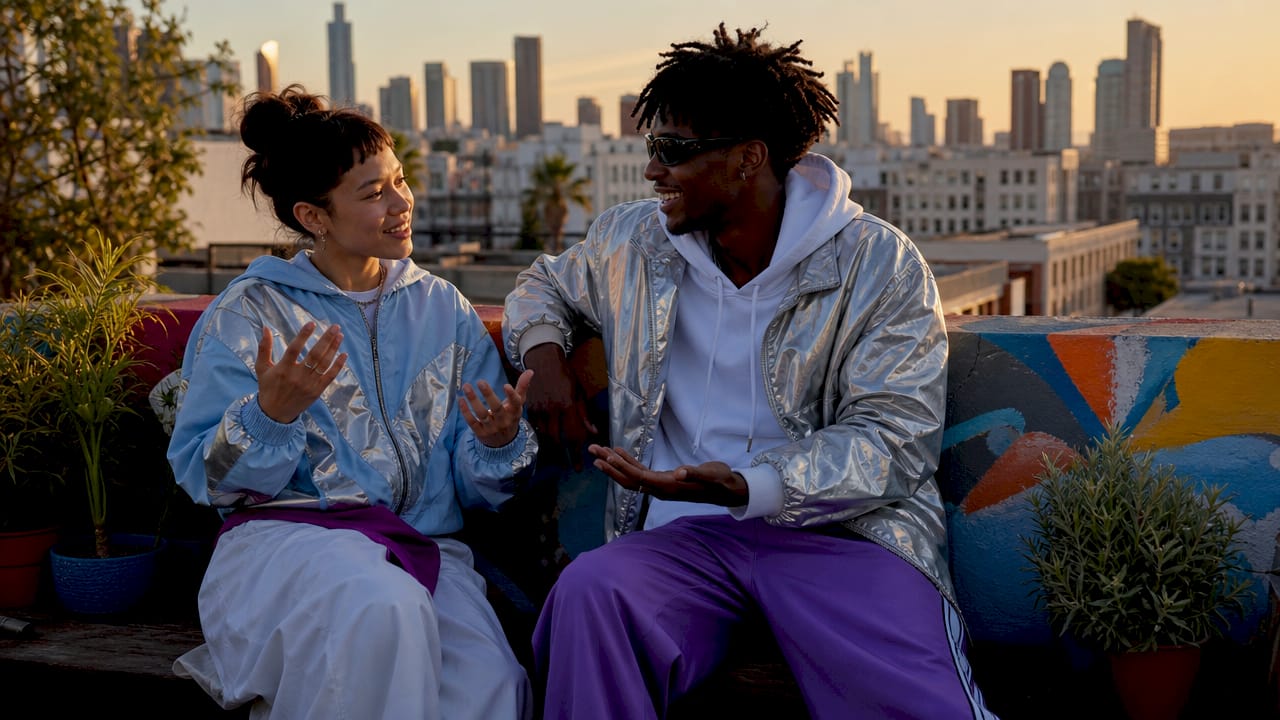
The engine underneath streetwear’s fashion cycle is human behavior, specifically the principle of optimal distinctiveness. A successful trend is “different enough but not too different” from what already exists, which is why revivals always come back with a modern update rather than an exact replica. People want to stand out and belong at the same time.
Community validation acts as the gatekeeper in streetwear. A style does not gain traction because a brand decides it should. It gains traction because respected figures within a scene wear it first and signal its legitimacy. This is why cultural authenticity rooted in skate, hip-hop, and surf culture still matters so much. A look without cultural roots gets rejected by the core community, which kills its credibility before it can even cycle properly.
Scarcity economics reinforce this dynamic at every stage. Limited drops and exclusivity keep demand artificially high during the acceleration phase. The moment a brand scales production to meet mass demand, it signals the beginning of the decline stage. Streetwear is now a $185 billion global industry, and the brands that have sustained relevance across multiple cycles are the ones that never abandoned scarcity as a core strategy.
“Older streetwear aesthetics repeatedly resurface because young consumers seek a blend of nostalgia and novelty that connects them to culture and community.” — Scientific American
The psychological pull of nostalgia is not random. It follows the same 20-year rhythm because the consumers who grew up with a style are now adults with purchasing power and a desire to reconnect with their formative years. That is not sentiment. That is a predictable market force.
How social media has compressed and fragmented streetwear cycles
Social media does not just accelerate streetwear fashion trends. It fundamentally changes their structure. Platforms like TikTok and Instagram spread new looks globally within days, compressing what used to be a multi-year trend arc into a matter of months. A style that would have taken two years to move from subculture to mainstream in 2005 can now complete that entire journey in a single season.
The result is a fragmented cycle landscape. Since the 1980s, fashion cycles have split into multiple simultaneous microtrends rather than one dominant look. In streetwear, this means gorpcore, techwear, Y2K revival, and old-money casual can all be peaking at the same time in different online communities. Each subculture runs on its own parallel sub-cycle.
| Trend type | Cycle speed | Primary driver | Decline trigger |
|---|---|---|---|
| Viral microtrend | 3 to 6 months | TikTok algorithm | Overexposure and fast fashion copies |
| Subculture trend | 1 to 3 years | Community validation | Mainstream retail adoption |
| Long-wave revival | 15 to 25 years | Nostalgia and novelty balance | Re-saturation of the revived aesthetic |
Fast fashion accelerates the decline stage by mass replicating limited-edition looks within weeks of their release. When a Shein or Zara version of a Supreme drop hits the market, the original’s cultural signal gets diluted almost immediately. Understanding fast fashion’s impact on streetwear is critical for anyone trying to track where a trend sits in its cycle.
Pro Tip: When you start seeing a streetwear aesthetic on fast fashion sites, that trend has already peaked. Shift your attention to what the original community has moved on to.
Today’s streetwear cycles combine a slow 20-year revival rhythm with short-term microtrend churn driven by social media and fast fashion. This two-layer rhythm explains why some aesthetics feel stable for years while others burn out in a single season.
How streetwear cycles differ from traditional fashion cycles
Streetwear’s fashion cycle analysis reveals a fundamentally different operating system compared to traditional fashion. The differences are structural, not just stylistic.
| Factor | Traditional fashion | Streetwear |
|---|---|---|
| Trend origin | Top-down from designers and runway | Bottom-up from subcultures and communities |
| Release model | Seasonal collections | Limited drops and surprise releases |
| Cycle length | 2 to 5 years per major trend | 6 months to 3 years depending on tier |
| Decline driver | Next season’s collection | Mass retail saturation and loss of exclusivity |
| Revival mechanism | Designer nostalgia collections | Community-led cultural memory |
Traditional fashion moves on a calendar. Streetwear moves on cultural momentum. A luxury house like Chanel plans its decline by releasing the next collection. A streetwear brand like Palace or Stüssy lets the community decide when a look has run its course.
The luxury crossover complicates this further. When Louis Vuitton collaborated with Supreme in 2017, it validated streetwear’s cultural capital but also accelerated the saturation of the Supreme aesthetic. The resale market adds another layer. Pieces that trade at three to five times retail on StockX or GOAT signal that a trend is in its acceleration or peak phase. When resale premiums collapse, the decline has begun.
The fragmentation of streetwear style evolution since the 1980s also means that different cities and online communities operate on parallel but distinct sub-cycles. What is peaking in Tokyo’s Harajuku district may still be in its introduction phase in Atlanta. Reading cycles accurately requires knowing which community you are tracking.
Key takeaways
Streetwear fashion cycles operate on a dual rhythm: a long-wave 20-year revival pattern layered over rapid social media-driven microtrend churn, with community validation and scarcity economics controlling every stage.
| Point | Details |
|---|---|
| Five-stage cycle structure | Streetwear moves through introduction, acceleration, peak, decline, and revival in a repeating pattern. |
| Psychology of optimal distinctiveness | Trends succeed when they balance novelty with belonging, which is why revivals always return with a modern update. |
| Social media compression | Platforms like TikTok shrink trend cycles from years to months, creating fragmented simultaneous microtrends. |
| Scarcity as a cycle signal | When limited drops go mass-market, the decline stage has started. Resale price drops confirm it. |
| Streetwear vs. traditional fashion | Streetwear cycles are community-driven and bottom-up, not calendar-based or top-down like traditional runway fashion. |
Reading the cycle before it reads you
The most common mistake I see young adults make with streetwear is treating trend cycles as something that happens to them rather than something they can read in advance. After years of watching how streetwear evolves, the pattern is clear: the community always signals the shift before the algorithm does.
The brands and individuals who stay ahead are not the ones chasing what is already trending on TikTok. They are the ones paying attention to what small, credible scenes are wearing before those scenes get discovered. A local skate shop’s house brand, a regional rap collective’s merch, an underground zine’s aesthetic. These are the early-stage signals that precede every major cycle shift.
The 20-year revival rhythm is real, but it is a population-level pattern, not a precise clock. The Y2K revival did not arrive exactly 20 years after Y2K. It arrived when a new generation of consumers was old enough to romanticize an era they barely lived through and when the cultural conditions made that nostalgia feel relevant again. Timing a revival means watching cultural mood, not a calendar.
What I find most compelling about streetwear’s cycle is that it rewards people who are genuinely embedded in culture rather than just consuming it. The best way to stay ahead of trends is to care about the communities that create them. Style follows substance in streetwear, every single time.
— Phazewrld
Stay ahead of the cycle with Phazewrld
Phazewrld builds its collections around exactly the cycle dynamics this article breaks down. The brand’s limited drops in men’s streetwear and women’s streetwear are timed to hit during the acceleration phase, not after the peak. The Y2K revival is one of the clearest cycle plays in streetwear right now, and Phazewrld’s Y2K graphic tees are designed to capture that nostalgia-meets-novelty energy before it tips into oversaturation. Free shipping over $99, easy returns, and price matching mean you can shop the cycle without the risk. Own the streets before the algorithm tells everyone else to.
FAQ
What are the stages of a streetwear fashion cycle?
Streetwear cycles move through five stages: introduction in a niche subculture, acceleration via social media and influencers, peak at mainstream saturation, decline when exclusivity is lost, and revival roughly 20 years later with a modern update.
How does social media affect streetwear trend cycles?
Social media platforms like TikTok and Instagram compress trend cycles from years to months by spreading new looks globally within days, which accelerates both adoption and oversaturation.
Why do streetwear trends come back after 20 years?
Researchers found measurable 20-year oscillations in fashion popularity because consumers who grew up with a style gain purchasing power as adults and seek nostalgia balanced with novelty, driving revival demand.
How can you tell when a streetwear trend is declining?
A trend is declining when its scene code gets diluted by mass retail availability and fast fashion copies. Collapsing resale premiums on platforms like StockX are a reliable secondary signal.
How is streetwear’s fashion cycle different from traditional fashion?
Traditional fashion runs on top-down seasonal calendars set by designers, while streetwear cycles are community-driven and bottom-up, governed by scarcity economics, drop culture, and cultural authenticity rather than runway schedules.